Beyond the Chatbot: Why Modern AI Agents Are Replacing Simple Automation
The era of rigid decision trees and brittle scripts is ending. Discover how autonomous AI agents are revolutionizing business workflows by moving from simple 'chat' to intelligent action.
For the past decade, "automation" in business has largely meant one thing: rigid scripts. You had Robotic Process Automation (RPA) bots that could copy-paste data between spreadsheets, provided the columns never moved. You had customer service chatbots that forced users down frustrating decision trees: "Press 1 for Sales, Press 2 for Support." If a customer had a question that didn’t fit the pre-programmed path, the system failed.
That era is closing. We are witnessing a fundamental paradigm shift—what industry analysts are calling the Agentic Shift. We are moving from software that simply follows rules to software that reasons and acts.
For business leaders, understanding the distinction between traditional automation (RPA/Chatbots) and modern AI Agents is no longer a technical triviality—it is a strategic necessity. Here is why the future belongs to the agents.
The Old Guard: The Limitations of "Mechanical" Automation
To understand the value of an AI agent, we must first look at what it replaces. Traditional automation tools, such as RPA and decision-tree chatbots, act as mechanical hands. They are incredibly fast and efficient at performing repetitive tasks, but they lack a brain.
- Brittleness: Traditional bots operate on strict "If/Then" logic. If a website interface changes, or if a customer phrasing varies slightly (e.g., "I want a refund" vs. "Give me my money back"), the bot often breaks or hits a dead end.
- High Maintenance: Because they cannot adapt, these systems require constant human intervention to update their scripts. The "automation" paradox is that they often create more work for IT teams to keep them running.
- Zero Context: A decision-tree bot doesn’t remember that you emailed last week about the same issue. It treats every interaction as Day One.
"Chatbots are like vending machines. AI agents are like personal assistants that anticipate your needs and get work done." — Salesforce, 2025
The New Era: What is an AI Agent?
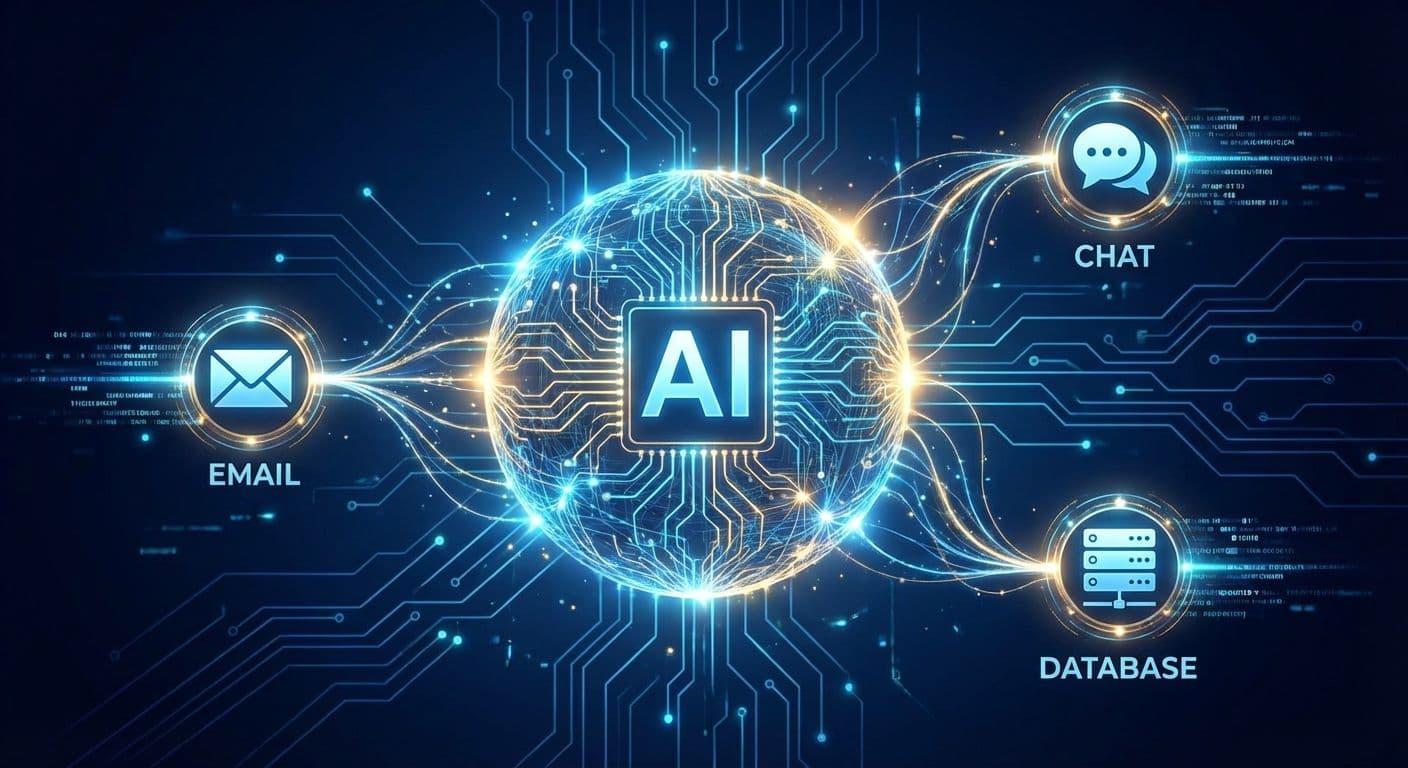
If RPA is the hands, an AI Agent is the brain and the hands. Modern agents are powered by Large Language Models (LLMs) that give them the ability to perceive, reason, and execute complex goals without a step-by-step script.
Key characteristics that define an AI Agent include:
- Perception: They can read unstructured data—emails, PDFs, Slack messages—and understand the intent behind them, not just keywords.
- Reasoning: When faced with an ambiguous request, an agent can formulate a plan. If a task fails (e.g., a database is down), the agent can retry or find an alternative route rather than crashing.
- Tool Use: Agents can autonomously wield software tools. They can access your CRM to look up a client, draft a personalized email, and schedule a meeting in your calendar, all in one flow.
- Memory: Agents maintain context over time, remembering user preferences and past interactions to provide a seamless experience.
Comparative Analysis: Agents vs. Bots
The difference between these technologies translates directly to operational efficiency and customer experience.
| Feature | Traditional Bot / RPA | AI Agent |
|---|---|---|
| Trigger | Specific keyword or rule | Natural language or goal |
| Data Handling | Structured only (Rows & Columns) | Unstructured (Text, Voice, Images) |
| Adaptability | Breaks if process changes | Adapts to changes in real-time |
| Scope | Single Task (e.g., "Reset Password") | End-to-End Workflow (e.g., "Onboard Employee") |
The ROI of Autonomy
Why should business owners care? The answer lies in Return on Investment (ROI) and scalability.
According to Gartner's Top Strategic Technology Trends for 2025, Agentic AI is set to autonomously resolve a massive percentage of business workflows that previously required human oversight. By 2028, Gartner predicts that at least 15% of day-to-day work decisions will be made autonomously through agentic AI, up from effectively 0% in 2024.
In a recent report, McKinsey described the rise of the "Agentic Organization," noting that companies deploying agents are seeing improvements not just in speed, but in the quality of output. Unlike a hurried human employee or a dumb bot, an agent follows every compliance protocol perfectly, every single time.
Real-World Use Cases
- Supply Chain Logistics: An RPA bot can track a shipment. An AI agent can notice a weather delay, autonomously re-route the shipment to a secondary distribution center, and email the customer with the update—all without a human manager lifting a finger.
- Complex Customer Support: Instead of deflecting customers to an FAQ page, agents can handle multi-step resolutions. For example, verifying a user's identity, processing a partial refund according to dynamic policy rules, and updating the inventory system simultaneously.
Conclusion: Prepare for the Shift
The transition from chatbots to agents is not just an upgrade; it is a replacement of the old operating model. Businesses that cling to rigid decision trees will find themselves competing against organizations that are fluid, responsive, and infinitely scalable.
To start your journey, audit your current automations. Look for processes where your current bots are failing or where human staff are acting as "glue" between disparate systems. These are the prime candidates for your first high-impact AI Agents.