The End of the "Contact Us" Black Hole: How AI SDR Agents Are Revolutionizing Lead Ingestion
Traditional lead forms are failing. Discover how autonomous AI SDR agents are replacing the "Contact Us" black hole with instant qualification, enrichment, and action.
For decades, the "Contact Us" form has been the digital equivalent of a black hole. A prospect fills it out, hits submit, and then... waits. Maybe they get an automated confirmation email. Maybe a human Sales Development Representative (SDR) sees it four hours later. Maybe they don't.
In a world where attention spans are measured in seconds, this latency is fatal. A seminal study by Harvard Business Review established the "5-minute rule": companies that respond to leads within five minutes are nearly 100 times more likely to connect than those who wait just 30 minutes. Yet, despite this knowledge, human teams struggle to keep up with the volume and velocity of modern inbound traffic.
Enter the AI SDR Agent. Unlike the rigid chatbots of the 2010s, these autonomous agents are not just waiting for input; they are actively ingesting, qualifying, researching, and nurturing leads the millisecond they appear. This isn't just automation; it is the complete architectural overhaul of the top of the sales funnel.
From Passive Forms to Active Agents
To understand the shift, we must distinguish between automation and autonomy.
- Automation (Traditional Chatbots): Follows a linear decision tree. If the user says "Pricing," the bot serves a link. If the user asks a complex question, the bot breaks or routes to a human who isn't online.
- Autonomy (AI Agents): Uses Large Language Models (LLMs) to reason. The agent understands intent, can look up external data to verify a company's size, decides if the lead fits the Ideal Customer Profile (ICP), and chooses the best next action—whether that's booking a meeting or politely disqualifying the lead.
According to the 6th Edition State of Sales Report by Salesforce, sales reps currently spend 70% of their time on non-selling tasks—data entry, research, and administrative work. AI agents reclaim this time by handling the entire "ingestion" phase of the lifecycle.
The Autonomous Ingestion Workflow
How does an AI SDR actually ingest a lead differently than a form? Let's break down the agentic workflow:
1. Instant Multi-Channel Capture
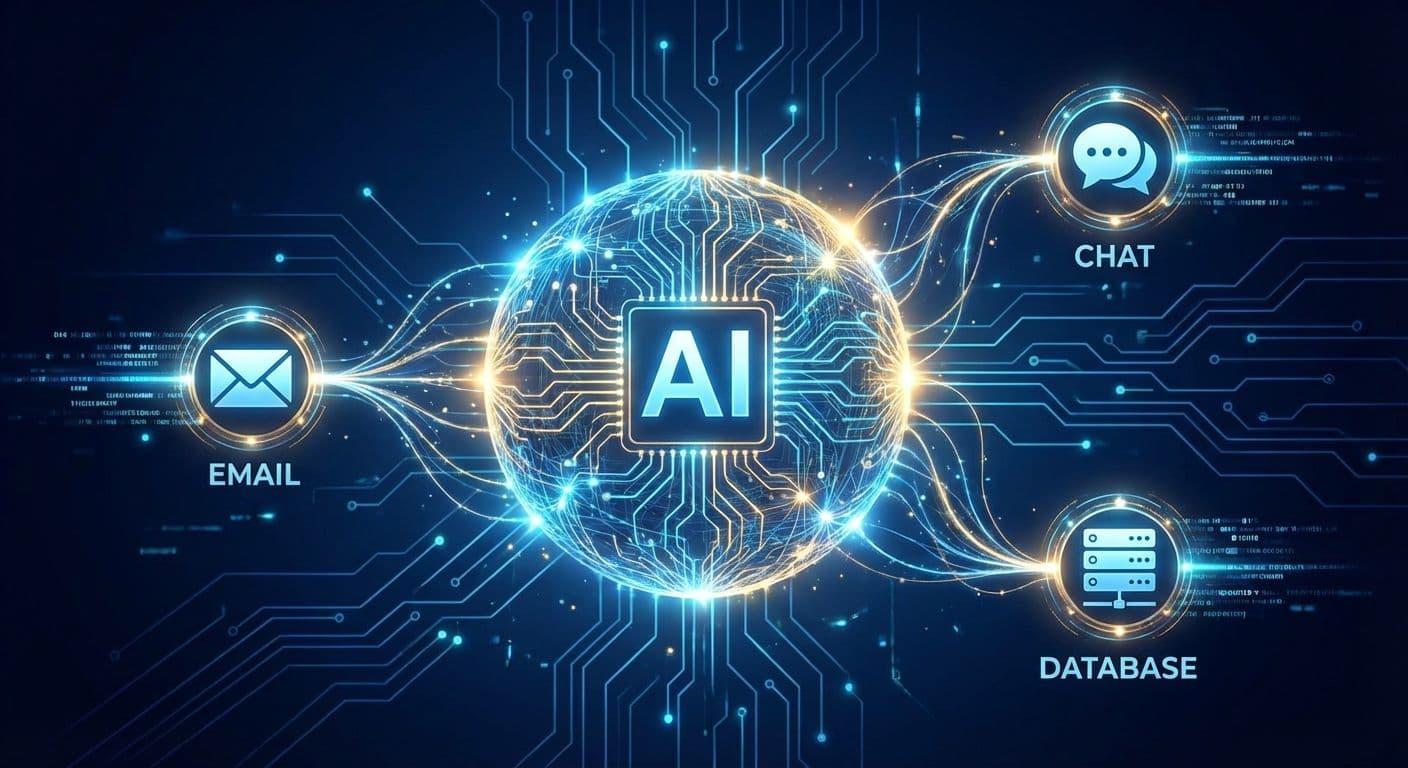
Agents don't just live on a landing page. They monitor email inboxes, LinkedIn DMs, and Slack channels simultaneously. When a lead signals interest, the agent captures it instantly, eliminating the data entry lag that plagues CRM systems.
2. Autonomous Qualification & Reasoning
Instead of asking a prospect 20 questions (which kills conversion rates), the agent asks two or three high-impact questions and infers the rest. It analyzes the tone, intent, and specific requirements in the prospect's message to determine urgency.
3. Real-Time Enrichment
This is the game-changer. While a human SDR might spend 15 minutes Googling a prospect, an AI agent can instantaneously query multiple databases to find the company's annual revenue, recent funding news, and tech stack. It appends this data to the lead record before the first response is even sent.
4. The Handoff (or The Kill)
If the lead is qualified, the agent has access to the Account Executive's calendar and books the meeting directly. If the lead is unqualified, the agent nurtures them with educational content or politely ends the engagement, keeping the human team's pipeline pristine.
The ROI of Agentic Ingestion
The business case for AI agents is not speculative; it is mathematical. By removing the latency between interest and action, companies are seeing dramatic improvements in funnel efficiency.
McKinsey's report on the State of AI in Early 2024 highlights that marketing and sales functions are seeing the highest adoption and value generation from GenAI. The report notes that early adopters are seeing revenue increases specifically driven by AI's ability to hyper-personalize outreach at scale.
"Sales teams that effectively deploy AI agents don't just respond faster; they respond smarter. They arrive at the first interaction already knowing the prospect's pain points."
Furthermore, Gartner predicts that by 2026, significant search volume will move to conversational agents, meaning your "ingestion" strategy must account for buyers who expect a conversation, not a form.
Implementation: Building the Machine
For business owners looking to deploy AI SDRs, the goal is not to replace the human sales team but to elevate them. Here is the implementation roadmap:
- Audit Your Ingestion Points: Where do leads currently enter your system? (Forms, Email, Chat).
- Define the "Golden Criteria": Explicitly teach the agent what a qualified lead looks like. Be specific about revenue, industry, and job title.
- Connect the Brain: Integrate the agent with your CRM (Salesforce, HubSpot) and your enrichment tools (Apollo, Clearbit). The agent is only as smart as the data it can access.
- Monitor and Refine: Treat the agent like a junior employee. Review its conversations weekly, correct its tone, and update its knowledge base.
Conclusion: The Autonomous Future
The era of the passive "Contact Us" form is ending. In its place rises the autonomous salesforce—agents that never sleep, never forget to follow up, and treat every lead with the urgency of a 5-minute response time.
For companies that adapt, the result is a cleaner pipeline, happier humans, and a lead ingestion engine that runs with the precision of a machine.